Kilimanjaro cost
Kilimanjaro cost
Climbing Kilimanjaro is one of those trips where the “price” you see online is only part of the story. Some costs are fixed by the national park, while others depend on route length, group size, comfort level, and how responsibly the crew is supported.
If you are budgeting from the United States, it helps to think in two layers: the packaged expedition cost (what you pay your operator) and the personal travel costs (what you pay directly before, during, and after the trek). The goal is not just to spend less, but to spend wisely so you stay safe, warm, well-fed, and properly supported at altitude.
Why Kilimanjaro pricing varies so much
Two people can “climb Kilimanjaro” and spend very different amounts while doing a trip that looks similar on the surface.
A longer itinerary costs more because every extra day triggers more official park fees and more wages, food, and logistics for the mountain team. That same extra day can also raise summit success because it gives your body more time to acclimatize. So a higher price is not automatically “luxury,” and a lower price is not automatically “a deal.”
Group size matters too. When you join a group departure, certain fixed costs are shared. Private climbs are more flexible and personal, yet they usually cost more per person.
Season can change operator pricing as well. Park fees stay steady, but demand affects staffing, hotel rates in Moshi or Arusha, and how far in advance good guide teams are booked.
The non-negotiable base cost: park fees and taxes
Every reputable Kilimanjaro climb includes official fees paid to the park authority. These are not optional, and they make up a surprisingly large slice of your total.
For international visitors, the big items are the daily conservation fee (about $70 per person per day) and the nightly accommodation fee: roughly $50 per night on camping routes, or about $60 per night for hut accommodation on the Marangu route. There is also a mandatory rescue fee (about $20 per person) and a forest fee (about $10 per person on most itineraries). VAT at 18% is added to these fees.
A simple way to sanity-check a quote is to estimate park fees yourself. If the total package price is near or below the park fee estimate, something is off.
| Example itinerary (per person) | Days in park | Nights in park | Style | Park fees before VAT (approx.) | Park fees with 18% VAT (approx.) |
|---|---|---|---|---|---|
| 7-day camping route (ex: Machame-style timing) | 7 | 6 | Camping | $820 | $968 |
| 7-day Marangu (huts) | 7 | 6 | Huts | $880 | $1,038 |
| 9-day camping route (ex: longer acclimatization plan) | 9 | 8 | Camping | $1,060 | $1,251 |
These figures are estimates based on published fee schedules and common itineraries. Operators typically bundle these fees into the package price and handle the payments and paperwork, which is exactly what you want.
What your operator price is really paying for
Once park fees are covered, the next major cost driver is what it takes to run a safe expedition: a trained guide team, fair wages, food, water treatment, tents, transport, and emergency readiness.
A quality operator also budgets for things you might not see, like replacing worn tents, keeping medical kits stocked, maintaining radios or satellite communication, and having oxygen available for emergencies. When a company emphasizes acclimatization with longer routes, that usually increases the cost, but it can improve the experience and lower the risk of altitude illness.
Here is what is commonly included in well-supported Kilimanjaro packages (always confirm in writing):
- Licensed mountain guides
- Park fees and rescue fees
- Guide-to-climber support: more staff means more attention, steadier pacing, and better monitoring
- Meals and safe drinking water: daily cooking fuel, food logistics, and water purification systems
- Mountain equipment: tents, dining shelter, sleeping mats, kitchen gear
- Transport logistics: transfers between Moshi or Arusha, the gate, and your hotel
Companies like Beyonds Average position their trips around safety and comfort-first support with licensed local guides and acclimatization-friendly itineraries, which is exactly where money tends to be well spent on Kilimanjaro.
Tips: budgeting for fair treatment and good morale
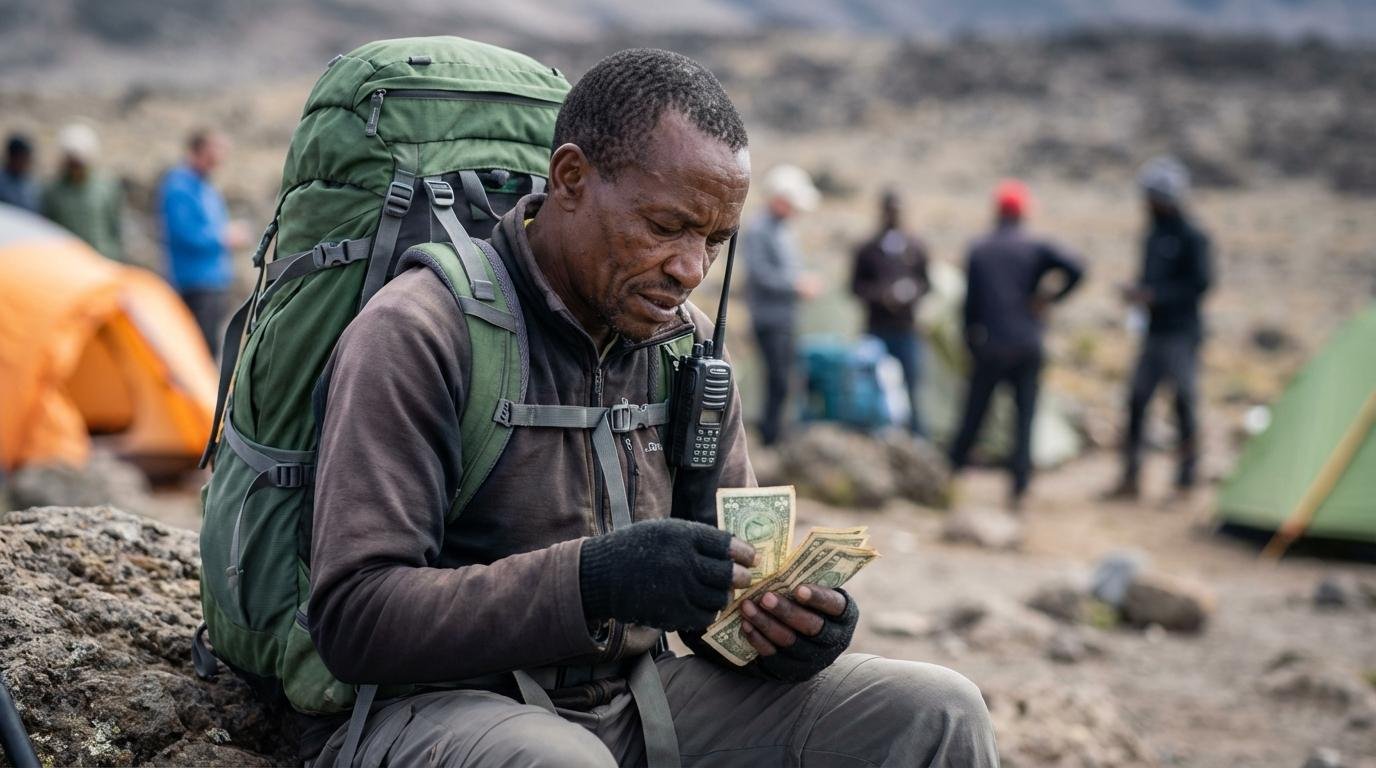
Tips are not a “nice extra” in practice. They are a normal part of the Kilimanjaro pay structure and are expected by crews across the mountain.
Most climbs have a lead guide, assistant guide(s), a cook, and a team of porters. Your package price should already include wages, meals for staff, and porter gear logistics. Tips are usually collected into a group pool and given near the end of the trek.
A practical planning range for a week-long climb is about $200 to $400 per climber, depending on group size and crew numbers. If you want a single budgeting figure, many trekkers choose around $300 per person for a 7 to 8 day itinerary.
Common tip guidance looks like this:
- Lead guide: $15 to $25 per day
- Assistant guide or cook: $15 to $20 per day
- Porter: $8 to $12 per day
- Tip pool logistics: cash in small bills, organized the night before the final day
If you are joining a group, ask the operator how they recommend handling tips so it feels fair and clear. A good briefing makes the last day calmer and avoids awkwardness.
Personal costs you control (gear, insurance, travel)
After the climb package itself, your personal choices have the biggest impact on total spend. You can save money here without reducing safety, as long as you plan ahead.
Gear is a common surprise. You do not need to buy everything new, and many climbers rent in Moshi or Arusha. Small items may rent for $5 to $15 each, and bigger items like sleeping bags and down jackets can be $25 to $50 per trip. If you are missing several essentials, budgeting $150 to $200 for rentals is reasonable.
Insurance is another area to treat as required, not optional. Your policy should cover high-altitude trekking up to roughly 6,000 meters, plus emergency evacuation. Many travelers spend $100 to $250 for a Kilimanjaro-focused trip length, depending on age and coverage.
Typical personal costs to plan for:
- Snacks and small purchases on the ground
- Gear rental: boots, poles, sleeping bag, insulated jacket if you do not own them
- Travel insurance: high altitude medical plus evacuation coverage
- Extra hotel nights: arriving early or staying longer for recovery
- Airport transfers: shared shuttle vs private vehicle
Flights to Tanzania vary widely by season and departure city, so it is best to budget those separately and early. Many international trekkers route through Kilimanjaro International Airport and stage from Moshi or Arusha.
Sample budgets: three realistic scenarios
The numbers below are meant to help you frame the total cost, not to replace a formal quote. They assume you are paying one price for a guided climb, then adding tips and personal expenses. International flights are not included.
| Scenario (per person) | Operator package (typical range) | Tips | Gear/insurance/extras | Estimated total (no flights) |
|---|---|---|---|---|
| Value-focused, longer group route | $2,200 to $2,900 | $250 to $350 | $250 to $500 | $2,700 to $3,750 |
| Comfort-forward, longer itinerary | $2,800 to $3,600 | $250 to $400 | $300 to $700 | $3,350 to $4,700 |
| Private climb or premium support | $3,500 to $5,000+ | $300 to $500 | $300 to $900 | $4,100 to $6,400+ |
What drives the jump from one scenario to the next is usually time on the mountain, staff ratio, hotel quality, and how private your experience is.
If you are comparing operators, also ask about payment flexibility. Some companies, including Beyonds Average, offer structured payment plans (including 0% interest options) that can make a longer, safer itinerary more accessible without cutting corners.
How to compare quotes safely
Kilimanjaro is not a place where “cheapest” is a meaningful win. When a quote is dramatically lower than the market, there is usually a reason, and it often shows up as risk: rushed itineraries, underpaid staff, inadequate food, poor tents, limited communication gear, or weak safety processes.
A safer comparison approach is to check what is included and how the operator runs the climb day to day. Ask direct questions and expect clear answers:
- Are all park fees, camping or hut fees, rescue fee, and VAT included?
- What is the guide-to-climber ratio on summit night?
- How is health monitored (pulse oximeter checks, symptom screening, decision authority to turn around)?
- What is the plan for emergency communication and evacuation coordination?
- How many acclimatization days are built into the itinerary?
If you get vague responses, treat that as useful information.
Planning smarter to spend less without cutting corners
You can often reduce your total trip cost while keeping a strong safety margin by making a few practical choices.
Arrive with most of your core clothing system already sorted, then rent only what makes sense locally. Book flights early, and consider shoulder seasons if you are comfortable with a higher chance of rain. Join a group departure if you are open to meeting other trekkers. Choose a longer itinerary that matches your fitness level rather than paying for a shorter route that increases the chance of failing to summit and feeling pressured to push too hard.
If you want help building a realistic budget for your dates, route preference, and comfort level, a good operator can walk you through expected inclusions, personal add-ons, and how to plan tips and insurance so there are no last-minute surprises in Moshi or at the gate.
All Categories
Recent Posts
best time to climb kilimanjaro
Kilimanjaro best operator